
![[keyword]](https://smartwealthnews.com/wp-content/uploads/2026/09/The-5-best-journal-apps-in-2026-scaled.jpeg "The 5 best journal apps in 2026")
There’s a reason so many successful people keep a journal: it works. Taking the time to gather your thoughts and experiences, then write them down, is a simple way to manage stress, enhance creativity, increase happiness, improve health, and increase work performance.
The trouble is, keeping a journal isn’t easy. It takes dedication to this new habit and a willingness to open up when writing on a blank page. What have you done today? Who are you, really? Journaling apps can help you figure this out and help you establish a daily writing routine.
After testing nearly two dozen options, these are the top journaling apps to record your memories this year and in years to come. Click on any app to learn more about why I chose it, or keep reading for more context on journal apps.
The best journaling apps
What makes the best online journal app?
How we evaluate and test apps
Our best apps roundups are written by humans who’ve spent much of their careers using, testing, and writing about software. Unless explicitly stated, we spend dozens of hours researching and testing apps, using each app as it’s intended to be used and evaluating it against the criteria we set for the category. We’re never paid for placement in our articles from any app or for links to any site—we value the trust readers put in us to offer authentic evaluations of the categories and apps we review. For more details on our process, read the full rundown of how we select apps to feature on the Zapier blog.
A paper notebook and pen are fine for journaling—in fact, for many people, they’re the best option. But apps are great if you’re a digital sort of person—plus, they give you more context on what you’ve accomplished and where you might want to go. They also let you include photos from your phone or posts from your social media feeds to make the journaling experience more rewarding. Add in reminders and the ability to search your journal entries, and digital journaling is almost a no-brainer.
I’ve been testing and writing about software professionally for nearly two decades. I’ve also journaled every day for years. It’s an important ritual for me, personally, and it’s also where a lot of the best ideas in my writing originate. In my experience, the best apps for keeping a journal have a few things in common:
-
Easy entry: If it takes more than a couple of clicks or taps to add a journal entry, chances are you’re not going to do it.
-
Pleasant interface: A minimalist, uncluttered interface helps you focus on your thoughts and makes journaling a pleasant experience.
-
Reminders: Perhaps the biggest challenge to online journaling is remembering to do it. Automatic reminders help you keep up the habit.
-
Exporting: In case the app stops being developed or you want to move to a different journaling platform, you’ll want to be able to export your entries in a format other programs can read, such as PDF or RTF.
-
Syncing: Syncing will make sure your journal’s up to date no matter what device you’re using.
-
Affordability: I eliminated some apps because of the high price. Journaling shouldn’t be expensive. If you’re looking for a free journal app, some of the options on this list will do the trick, just with fewer features than the premium plans.
Other features for a digital journal that might be important to you include password protection, Markdown support, the ability to add more than one photo, location and weather tags, and journaling prompts.
Keep in mind that this article is focused on general-purpose journaling apps. That means apps that are built around one specific purpose—for example, mental health—aren’t included. The journal apps on this list can all be used for whatever purpose you like: business, personal development, or anything else you might want to write privately about every day.
To update the list this year, I spent time testing every diary app I could get my hands on. For each one, I started by creating a handful of new entries, complete with images. I then spent some time exploring the settings, testing the daily reminders, and ensuring that syncing and exporting worked as described. These are the journal apps that came out on top.
The best journal apps at a glance
|
Best for |
Standout feature |
Pricing |
|
|---|---|---|---|
|
Cross-platform journaling |
Customizable multiple reminders |
Free version available; from $49.99/year for premium features |
|
|
One-time fee |
Configurable reminders |
Free version available on Android ($14.99 for Pro), iOS ($14.99 for Pro), and macOS ($14.99 for Pro); Windows version for $19.99 |
|
|
Apple users |
Totally free and functional |
Free |
|
|
Templated journaling |
Grid of recurring questions for daily reflection |
Free version available; paid version from $2.99/month for syncing, encryption, unlimited journals, and exporting to PDF |
|
|
Journaling over email or AI |
Journal by responding to emails, with complete archive view |
Free version available; starts at $4/month to get reminders |
Best journal app overall
Day One (Windows, macOS, Android, iOS, watchOS)
Day One pros:
Day One cons:
Since its release in 2011, Day One has been one of the most highly recommended journaling apps for Apple devices. More recently, they added a Windows version—the app is well regarded on both platforms.
It’s not hard to see why. The app offers a wide array of features—just about everything you might want or need in a digital journal. You can use templates to make journaling easier. You can automatically add metadata, such as location, weather, motion activity, currently-playing music, and step count, to your entries. You can also tag entries with hashtags, insert photos and videos, password-protect your journal, and format entries in Markdown. And there are optional prompts, if you’re not sure what to write about (there’s a fresh one every day).
All of this is within an elegant, unobtrusive design that fits into all four major platforms. There are no gaudy, cluttered toolbars in sight—everything on the screen is useful for journaling.
Perhaps Day One’s best feature is the ability to customize multiple reminders. Most other journal apps only send you one reminder during the day. But with Day One, you can get prompted to write, say, when you start the day, at lunchtime, and then at the end of your workday to keep track of your activities and thoughts throughout the day.
The free app offers pretty much all of the core journaling features, but for syncing, unlimited photos, handwritten and audio entries, and multiple journals, you’ll need to subscribe to the Day One Silver plan.
Day One now offers a variety of AI features, though only in its $75/year Gold tier. These allow you to add journal entries by conversing with a chatbot, generate journal prompts based on past entries, and even generate images right inside the app. If these features don’t appeal to you, no matter: the app works well without them and doesn’t go out of its way to upsell you.
You can even automate entries in Day One with Zapier. If there are things you wish showed up in your journal automatically—a song you liked in Spotify, for example, or specific Notion database items—Zapier can take care of it for you.
Day One pricing: Free version available; starting at $49.99/year for Silver
Best journal app with a one-time fee
Diarium (Windows, macOS, Android, iOS)
Diarium pros:
-
Native apps for Windows, macOS, iOS, and Android
-
Configurable reminders
-
Syncing with multiple cloud services
-
Export to multiple formats
Diarium cons:
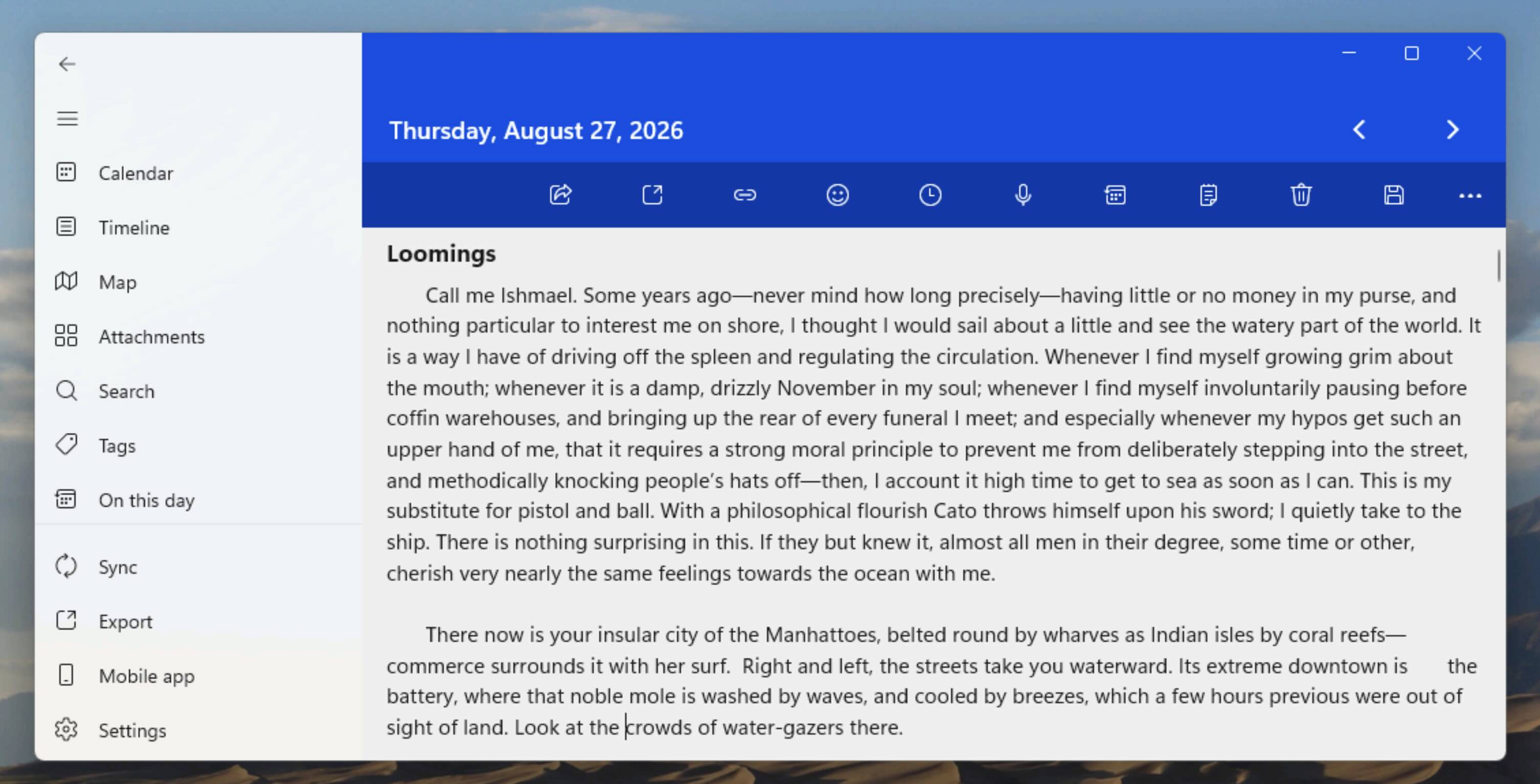
Diarium offers beautiful native apps for every platform. The Windows application, in particular, is nicer than any other I could find.
But there’s so much more to recommend here on all operating systems. You can add multiple media types to your journal entries. If you’d rather speak than type, you can dictate your thoughts with accurate speech recognition. You can attach an audio file, inked drawing, or any other type of file to your entries, as well as multiple photos. Heck, you can even rate your journal entries (perhaps most useful as a way to track how happy you are each day).
Diarium works without any sign-in, or you can sync using your choice of cloud apps—OneDrive, Google Drive, Dropbox, or WebDAV. You can also export your entries to DOCX, HTML, JSON, or TXT formats—with separate files for media attachments—so you can rest assured that your data will always be accessible.
To make journaling even easier, Diarium can automatically pull in feeds from Facebook, Untappd, Trakt, or Last.fm; or fitness apps, like Strava. It can also pull in your calendar appointments and even the day’s weather. Combine this with daily reminders and beautiful native apps for every platform, and you’ve got a great cross-platform journal app.
The standout thing, though, is that you get all of this without any kind of ongoing subscription—you just need to pay once, per platform.
Diarium pricing: The Windows version costs $19.99. There are free versions for Android, iOS, and macOS, with an optional $14.99 one-time payment per platform to upgrade to Pro.
Best free journal app for Apple users
Apple Journal (macOS, iOS)

Apple Journal pros:
Apple Journal cons:
Apple launched their journal app in 2023, initially only on iPhone. It was a great way to keep a personal journal on your phone, but it was missing something: the ability to write on a computer, with an actual keyboard. No more: now the app syncs between all of your Apple devices, giving you a way to start a journal and add entries on your phone, computer, and tablet.
The heart of the application is just typing, but there’s support for adding or taking pictures, adding your location, and recording a voice memo. You can also optionally add the current location to every entry.
You’re not going to find the bells and whistles of the above two apps here—there’s no integrations with other applications, no prompts, and no simple way to import entries from other apps. Exporting is limited to a folder of HTML files, which isn’t ideal.
Even so, this is a solid journal app that’s totally free to Apple users. If you spend your digital life on an iPhone, iPad, or Mac, try this one before anything else.
Apple Journal pricing: Free
Best journal app for templated journaling
Grid Diary (macOS, Android, iOS)
Grid Diary pros:
Grid Diary cons:
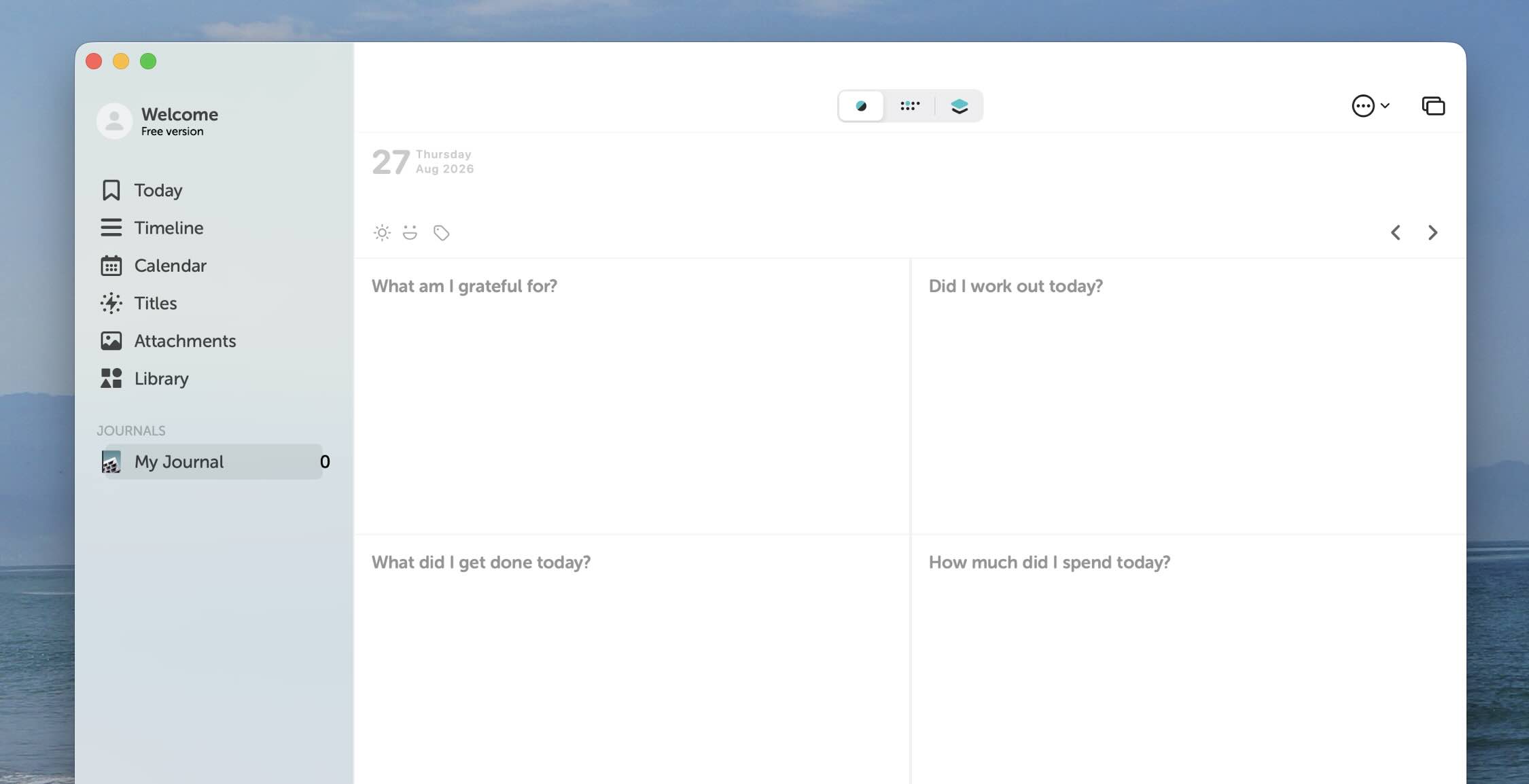
Grid Diary bills itself as “the simplest way to get started with keeping a diary.” Instead of a blank slate, this diary app gives you a grid of boxes you can give custom headers to. The defaults are things like “What am I grateful for?” or “What did I get done today?” though you can customize these to say whatever you want.
This gives you a detailed and bird’s-eye view of what’s happening in your life, one day at a time. You can review entries using the built-in calendar, or you can use the Titles view to review all entries for a particular grid. There’s also support for attachments, private journals, and syncing between multiple devices if you’re using the paid version.
Instead of wondering what you should write about each day, use Grid Diary to write down simple responses that help you reflect on your days.
Grid Diary pricing: Free version available; paid version from $2.99/month for syncing, encryption, unlimited journals, and exporting to PDF.
Best journal app for journaling over email or AI
Dabble Me (Web)
Dabble Me pros:
Dabble Me cons:
The main problem with journal apps: you have to remember to open them. Dabble Me doesn’t have this problem because it works entirely over email, or via your favorite chatbot.
The paid version ($4/month) will email you once a day, reminding you it’s time to journal—respond to that email, and you’ve journaled. The free version doesn’t give you the daily prompts, but journaling is still as easy as writing an email—you can find a custom email address to send entries to in the settings.
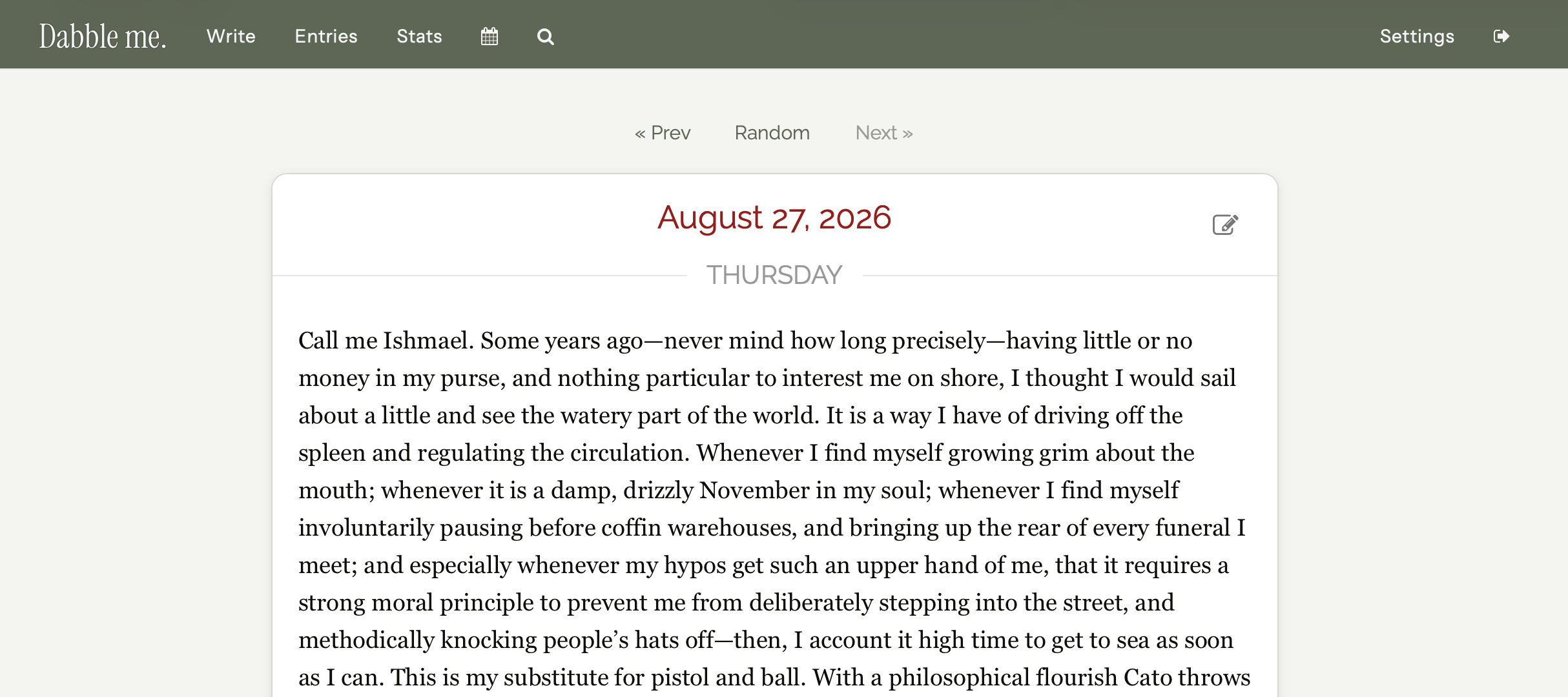
You can see the complete archive of your journals on the website, which also offers search, a calendar view, and even a page for reviewing and listening to any Spotify links you’ve included in your entries. And there’s support for exporting your entries to TXT or JSON files, so you can take your entries with you should you decide to shut down your account.
If you’re a heavy AI user, Dabble offers an MCP server. This allows you to ask Claude, ChatGPT, and other AI platforms about your journal entries. You can even add entries using your bot, if you want. It’s great if you want an AI journal that lives inside your existing workflow.
Dabble Me pricing: Free version available; Pro, with reminders and MCP, starts at $4/month.
Should you use a journaling app?
You don’t necessarily need a dedicated diary app for journaling—lots of people, after all, use a simple notebook for the job. Some other categories of apps can also work perfectly well.
-
The best note-taking apps all work really well for journal entries. Just make a new notebook and create a new entry every day.
-
If you don’t feel like writing every day but would still like to keep track of your feelings over time, there are a number of mood tracking apps on the market. I’ve tested and like Daylio.
-
5 Minute Journal is only available on Android and iOS, but its simple approach makes it a great option for beginners (with timed prompts throughout the day). It’s based on the popular paper journals of the same name—and it’s focused mostly on building a gratitude habit.
-
You can make your own digital bullet journal using a tool like Trello or Airtable.
-
If you really want something custom, you can build your own journal app with no code using Zapier.
As always, the best tool for the job is the one that works best for you. If something helps you start a journaling habit and stick to it, use that.
Related reading:
This article was originally published in January 2019 by Melanie Pinola and has previously had contributions from Emily Esposito. It was most recently updated in September 2026.