
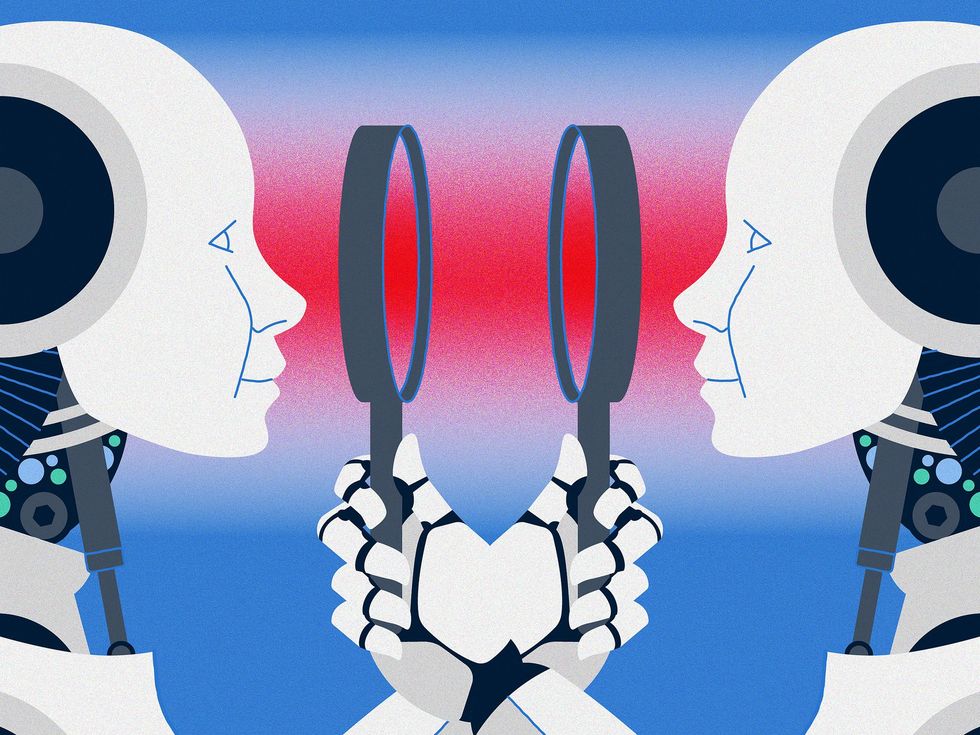
The field of artificial intelligence was built on the premise that machines might someday improve themselves. In 1966, the English mathematician I. J. Good wrote that “an ultraintelligent machine could design even better machines; there would then unquestionably be an ‘intelligence explosion,’ and the intelligence of man would be left far behind.” AI researchers have long seen recursive self-improvement, or RSI, as something to both desire and fear. Today, advances in AI are raising the question of whether parts of that process are already underway.
RSI means many things to many people. Some use the idea as a bogeyman to scare up regulation, while others brandish it in marketing. For some, it means a fully autonomous loop, while for others it’s nearly any use of tech to build tech.
Safest to say it’s a spectrum. At its strictest, researchers use the term to describe systems that can improve not just their outputs, but the process by which they improve—generating ideas, evaluating results, and modifying their own methods with zero human direction. By that standard, many of today’s systems fall short. They can help build better AI, but they still rely on humans to set goals, define success, and decide which changes to keep. The question is not whether self-improvement exists in some form today, but how much of the loop has actually been closed.
Stepping Stones to Self-Improvement
Researchers have spent decades putting in place the elements of RSI. Machine-learning (ML) algorithms automatically tune the parameters of programs that can play games or even create new programs. ML methods called evolutionary algorithms diversify and iterate on design solutions, including other algorithms. Over the last decade, “AutoML” has automated aspects of the pipeline in which ML models such as neural networks are structured, trained, and evaluated.
Today, large language models (LLMs) such as GPT, Gemini, Claude, and Grok extend this trend. One of their biggest use cases is to write code, including the code to produce future versions of themselves. In February, OpenAI reported that GPT‑5.3‑Codex was instrumental in creating itself, helping to debug training, manage deployment, and analyze evaluation results. Anthropic claims that the majority of its code is now written by Claude Code. These systems still rely on humans to direct and verify the work.
Last year, Google DeepMind announced a system called AlphaEvolve, “a coding agent for scientific and algorithmic discovery.” It uses LLMs to guide the evolution of solutions, such as optimizing neural-network architectures, data-center scheduling, and chip design. It’s not a fully recursive loop, as people still need to decide what problems AlphaEvolve should solve and how to evaluate its performance. But each breakthrough enhances scientists’ ability to make further AI breakthroughs.
“It’s also a very collaborative process” between humans and machines, says Matej Balog, a computer scientist at Google DeepMind who worked on AlphaEvolve. “Often you look at what the system discovers, and you actually learn from that discovery.” The system has already surprised the team. “Our mission is to use AI to discover new algorithms that have evaded human intuition,” Balog says, and “I think we have the first demonstrations that this is not a wild dream.”
Meanwhile, the co-leads of Google DeepMind’s earlier chip-design system, AlphaChip, have launched a startup called Ricursive Intelligence to use AI to design AI chips. “We expect that we can dramatically reduce the design cycle from one or two years to days,” says cofounder Azalia Mirhoseini. Phase 1 is to help human designers. Phase 2 is to automate the process for companies without in-house designers. In Phase 3, the company will recursively use AI to design better chips to train better AI—though still under human supervision, says cofounder Anna Goldie.
Other projects focus on AI agents modifying their own behavior. Last year, scientists at the University of British Columbia and Sakana AI announced Darwin Gödel Machines (DGMs), which use evolutionary algorithms to improve LLM-based coding agents. Critically, agents can alter their own code (though not the underlying LLM), and get better at doing so. A newer version can even alter its meta-mechanisms for improving itself.
Members of the team also developed the AI Scientist, reported in Nature in March, which aims to automate the broader research loop. It can generate research ideas, run experiments in software, write up the results in papers, and then review those papers. This project hints at how more of the AI development process—not just coding, but experimentation and evaluation—could be folded into an automated loop.
Jeff Clune, a computer scientist at the University of British Columbia who worked on both DGMs and the AI Scientist, says that improving AI with AI is “one of hottest topics in Silicon Valley.” He believes that “we are right around the corner from recursively self-improving systems,” and argues that RSI will rapidly “transform science and technology and all aspects of society and culture.”
Why AI Self-Improvement Still Has Limits
Many barriers remain. Clune says that AI is merely decent at generating, implementing, and judging ideas. “All of the key pieces work OK but not great,” he says. Dean Ball, a senior fellow at the Foundation for American Innovation, says that AI scientists still don’t match the best human scientists. “Maybe eventually they’re going to automate the genius,” he says, “but not next year. Next year they’re automating the grunt who grinds through the algorithmic efficiency games.”
Even if those capabilities improve, the process may not compound cleanly. Nathan Lambert, a computer scientist at the Allen Institute for AI, recently wrote an essay arguing that instead of recursive self-improvement, we should expect “lossy self-improvement (LSI),” in which increasing friction slows the flywheel. That’s in part because large AI systems are growing more complex, and the job of an AI researcher will be to manage that complexity rather than to refine parts of the system. Further, top systems cost billions of dollars to develop, and no one wants to set an AI loose with that kind of cash.
There are also broader constraints. Ball has written about RSI and why he’s not a “doomer”—someone who believes the phenomenon will take off and destroy civilization. Taking over the world, he argues, requires many practical steps, from running lab experiments to navigating politics. Further, knowledge is distributed and often tacit, so can’t easily be bundled into one AI mind. For example, the capabilities of the chip-manufacturer TSMC emerge from the collective intelligence of its 90,000 interacting employees.
Full-on RSI might require not just designing software and chips but building data centers, running power plants, and mining metals, all using self-reproducing robots. For these and other reasons, some researchers argue that humans will remain central to the process. Meta researchers Jason Weston and Jakob Foerster recently wrote that instead of self-improvement, “a more achievable and better goal for humanity is to maximize co-improvement.” Keeping humans in the loop will lead to both faster and safer progress, they write, as people lend their insights and also steer AI toward solutions that benefit humanity.
Could RSI End the World?
Still, many scientists haven’t ruled out runaway RSI, sometimes called the singularity. Last year, researchers interviewed 25 AI experts about automating AI R&D. All but two entertained the notion that it could lead to an intelligence explosion. Participants were also more likely to think that AI companies would keep their self-improving models internal rather than deploy them publicly. “It’s a pretty alarming combination, right?” says David Scott Krueger, a computer scientist at the University of Montreal who co-authored the paper. He worries about research so risky happening “outside the public eye.”
Krueger, who founded an AI-safety nonprofit called Evitable, advocates for globally pausing AI development. “It’s gambling with everyone’s lives,” he says. One red line he has suggested for triggering the pause is when 99 percent of code is written by AI. “That’s one that I think we’re maybe crossing about now.”
Even though Ball calls the singularity “totally childish sci-fi bullshit,” he believes frontier AI labs conducting RSI research should be closely monitored so that their models don’t fall into the wrong hands, such as bad actors who could use them to accelerate the development of cyberattacks or biological weapons. RSI has risks, he says, but they can be managed.
Society of Artificial Minds
When people picture RSI, they might envision one big-brained AI growing bigger-brained. But it might look more like evolution, where many diverse agents emerge and act together. Krueger says there could be “something like a Cambrian explosion of artificial life forms.” They’d have ecosystems, cultures, and economies.
Clune believes evolutionary algorithms and open-ended processes, which explore without a strong objective, will be key to RSI. Collaboration between agents will also help. Systems like the AI Scientist, which packages its findings into formal papers, offer one way for agents to share results and build on each other’s work. “It’s a pretty good way for the system to communicate with other agents,” Clune says.
Human scientists might get edged out of AI research, but slowly. First, Clune says, they’ll spend less time on lower-level tasks and become more like professors or team leads, who pick research directions. Then people will be more like program officers or CEOs, who set broader research agendas. Finally, they’ll conduct oversight, a role he hopes humans never forfeit. Clune says he might be sad if a machine replaces him as an AI scientist, a role he finds “exhilarating.” But the payoff could be worth it. “I’ll give up my hobby to cure cancer.”
From Your Site Articles
Related Articles Around the Web